
What Is Emotional Regulation in Children? A Guide for Parents

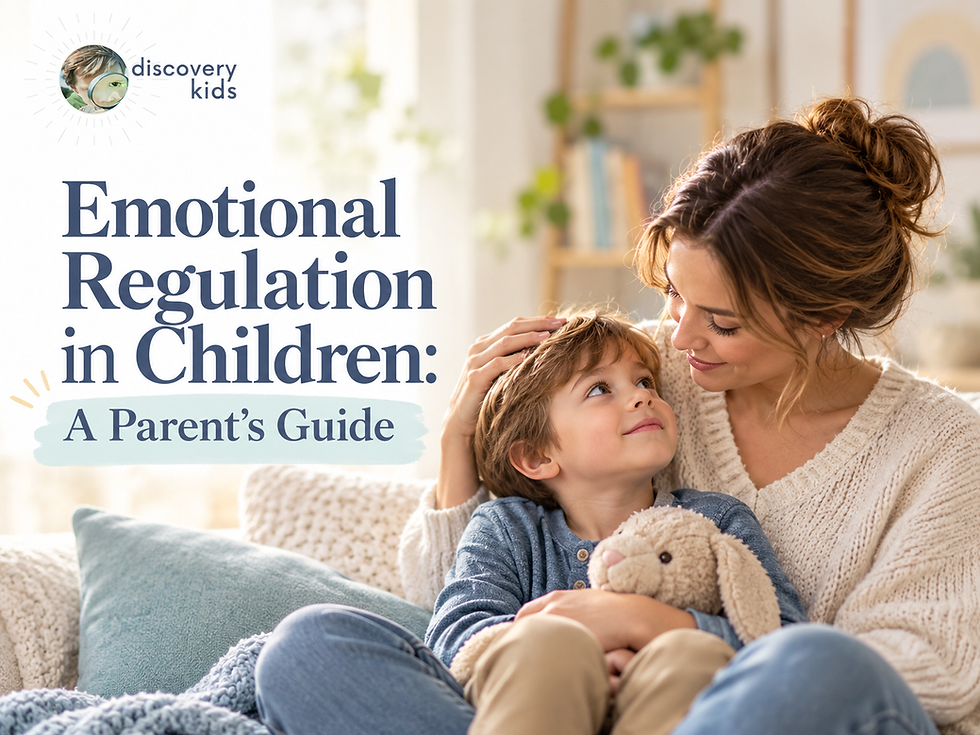
Emotional regulation in children is their growing ability to notice how they feel and express it in a safe, age-appropriate way. It doesn't mean a child stops crying or getting frustrated. It means they gradually learn to handle those feelings without hurting themselves or others, usually with a lot of adult support along the way.
One minute your child is happily playing. The next, they're in tears, or refusing to budge, or completely melting down over something small. Parents find these swings exhausting. They're also completely normal.
Emotional regulation is a skill kids build over time: noticing what they feel, then finding a safe way to show it. Crying, anger, and frustration don't go away as children grow. What shifts is how well they read their own feelings and how they act on them.
Kids don't learn these skills from a lesson. They pick it up slowly, through everyday relationships and routines, guided by the adults around them.
What Is Emotional Regulation in Children?
Simply, it's a child's growing ability to notice what they're feeling and do something useful with it.
For a toddler, that might look like using words instead of hitting when they're frustrated. A pre-schooler might ask an educator for help when a game doesn't go their way. Older children tend to pause, think a problem through, or reach for a coping strategy without being told to.
It helps to be clear on what emotional regulation isn't. It's not about controlling or suppressing feelings. Anger, sadness, fear, and disappointment are all normal to feel, and kids need to know that. What they're building is the skill of expressing them without hurting themselves or anyone else.
Self-regulation and co-regulation
Self-regulation is a child's ability to manage their own behaviour and reactions. It builds slowly, starting in the toddler and preschool years and continuing well into childhood. Raising Children Network puts it simply: self-regulation is being able to understand and manage your behaviour, and your reactions to your feelings and to what's happening around you.
Co-regulation is different. It's the support a child gets from a calm adult when they can't yet manage a strong emotion by themselves. That might mean a parent staying close, dialling down the noise in the room, or just naming the feeling out loud for the child.
Most young children lean on co-regulation a lot before they can reliably self-regulate.
Why Emotional Regulation Matters in Early Childhood
Emotional regulation shapes far more than a single difficult moment. Relationships, communication, and learning are all touched by how well a child can manage their emotions.
Australia's Early Years Learning Framework (EYLF) V2.0 places emotional regulation under Outcome 3, which focuses on children's social, emotional, and mental wellbeing. It describes children learning, bit by bit, to understand and manage their emotions. Educators support that growth through responsive relationships.
Young children are still developing the skills they need to pause, manage impulses, and adjust to changing situations. A child who's tired or hungry will find all of that much harder.
That's part of why responsive relationships matter so much. ACECQA's guidance on responsiveness to children makes a similar point: when adults respond warmly and consistently, kids feel more secure, and they're more willing to take on new challenges.
Kids with stronger emotional regulation find it easier to join group activities and handle disappointment. It also helps them build friendships and speak up about what they need.
How Does Emotional Regulation Develop by Age?
Every child moves at their own pace, so treat the ranges below as a rough guide, not a checklist. Temperament and everyday experience shape the timeline just as much as age does.
Age | What emotional regulation may look like | How adults can support it |
Toddlers (1–3 years) | Strong emotional reactions, frequent frustration, difficulty waiting and limited ability to explain feelings | Name emotions, stay close, use simple language and provide predictable routines |
Preschoolers (3–5 years) | Growing emotional vocabulary, beginning to wait, negotiate and ask for help, but still experiencing occasional outbursts | Model calm behaviour, prepare for transitions and practise coping skills through play |
Primary school age (5–8 years) | Greater independence, improved understanding of other people's feelings and increasing use of coping strategies | Encourage problem-solving, reflection and age-appropriate responsibility |
There's no single moment when a child suddenly becomes "emotionally regulated." Progress creeps forward, and slips backward, especially around illness, big changes, or just a bad night's sleep. Wondering when to start your child in a group learning setting?
Our guide to the best age to start early learning in Australia looks at how development at each stage feeds into that decision.
Why Do Children Struggle to Regulate Their Emotions?
A big reaction doesn't automatically mean a child is being difficult on purpose.
Kids struggle when they're tired, hungry, or frustrated. Unfamiliar situations trip them up too, and so do transitions between activities, especially when a child is deep in play and doesn't want to stop.
Some children get overwhelmed by noise or crowds. Others simply haven't built the language yet to cope with disappointment.
And the trigger you can see rarely tells the whole story. A child who melts down over a missing toy might already be running on empty after a long day.
None of this points to poor parenting. A child's temperament, their stage of development, and their environment all shape how they respond to emotions. What actually matters is how the adults around them respond, and how many chances the child gets to practise.
Signs Your Child May Be Struggling With Emotional Regulation
Crying, tantrums, and outbursts are a normal part of childhood. One rough afternoon doesn't mean much on its own.
Start paying closer attention if the reactions seem unusually intense for the child's age, or if they take a long time to settle. It's also worth noting if they're regularly getting in the way of family life, friendships, or school.
Look for patterns rather than judging a single incident. When does it happen? What came right before it? And what actually helps your child recover?
If you have ongoing concerns, talk to your GP or child health nurse. They can look at your child's specific situation.
Practical Ways to Help Children Manage Emotions
You don't need a big outburst to start working on this. Most of the groundwork happens in ordinary, everyday moments.
Name and validate feelings
Give your child's emotion a simple name and acknowledge what they're going through.
Try something like: "You're really frustrated because we have to leave the park."
That's not the same as agreeing to unsafe behaviour. It just tells your child you've noticed how they feel, and that it's okay to feel that way.
Model calm behaviour
Kids learn a lot from watching the adults around them. When you're frustrated, try saying it out loud: "I'm feeling frustrated, so I'm going to take a breath before I answer."
You won't get this right every time. That's fine. Letting your child see you feel something strong, stumble, and recover teaches them plenty on its own.
Prepare for transitions
Give children a heads-up before an activity ends. Something as simple as "Five more minutes, then we're packing away" can soften a sudden change.
Predictable routines help too. ACECQA's guidance on continuity of learning and transitions points to steady routines and supportive relationships as the two biggest factors in smoother transitions.
Give children manageable choices
A small choice can hand a child an appropriate sense of control.
Rather than an open-ended question, try: "Would you like to put your shoes on first, or pack your bag first?"
You're still setting the boundary. The child just gets some say in how they get there.
Create a calm space
A calm-down corner or quiet spot gives a child somewhere to settle when things feel like too much. Cushions and a few familiar toys are usually enough.
This isn't about isolating or punishing a child for having a feeling. It's a safe space where they can settle down with some support nearby.
Practise coping skills when children are calm
Deep breathing, counting, or simply asking for help are all far easier to learn when a child is already calm.
Build these habits during ordinary moments, so they're second nature by the time your child actually needs them. Unstructured, child-led play is one of the easiest settings to build them in, too. Our piece on why unstructured play matters for school-age children digs into how that kind of play supports self-regulation as kids get older.
What Should You Do During a Meltdown?
Long explanations rarely help in the middle of a meltdown. What matters most is safety, and helping your child settle.
Keep your own voice calm and your words simple: "You're very upset. I'm here with you."
Move somewhere quieter if the environment is noisy. If your child is hitting or throwing things, step in calmly, hold the boundary, and make sure no one gets hurt.
Once things have settled, talk through what happened, briefly, and focus on what they might try next time.
You're not trying to make a child stop feeling upset. You're helping them move through the feeling safely, and build better ways of coping over time.
How Do Early Learning Centres Support Emotional Regulation?
Alt Text: Educator helping a toddler with emotional regulation in a calm-down corner.
Children get chances to practise emotional regulation all day long. Waiting for a turn, sharing toys, and sorting out a disagreement with a friend are ordinary moments, but they're where kids actually build the skill, not in a lesson plan. They're the same everyday moments that shape what kids actually do at OSHC once they reach school age.
In an early learning setting, educators pick up on a child's emotional cues, offer reassurance, and help them name their feelings. That fits squarely with what the EYLF V2.0 asks for under Outcome 3: wellbeing, built through responsive relationships.
In Balcatta, Discovery Kids Early Learning Centre takes children aged 2 to 5 and runs its program across both indoor and outdoor spaces. The curriculum mixes intentional teaching with child-led opportunities, and families have a say in shaping it too.
If you're comparing early learning centres, ask how educators respond when children get upset, and how transitions are handled. Our guide to choosing the best early learning centre in Perth covers the other questions worth asking on a tour.
When Should You Seek Extra Support?
Emotional ups and downs are part of most children's lives. Still, it's worth getting professional advice if your child's reactions are persistent or clearly getting in the way of their day-to-day life.
Your GP or child health nurse is a good place to start. They'll know your child's development well enough to point you in the right direction.
You don't have to wait until things get severe before reaching out. Getting support early can help you understand what's driving the difficulty.
Help Your Child Build Emotional Skills at Discovery Kids
Children build emotional regulation through everyday experience, relationships, and play. At Discovery Kids, families can explore an early learning environment built to support that growth, step by step.
Considering early learning in Balcatta? Contact Discovery Kids with any questions, or book a tour of the ELC to see it in person.
Ready to take the next step? Enrol now to start the process.
FAQs
What is emotional regulation in simple terms?
It means noticing what you feel and finding a safe way to show it. Kids build this up slowly, with plenty of support and practice along the way.
What age do children develop emotional regulation?
It gets going in the toddler and preschool years, and keeps building well beyond that. The younger the child, the more they'll lean on you for co-regulation before they can do it alone.
What is the difference between a tantrum and a meltdown?
A tantrum is usually tied to frustration or a specific goal. A meltdown is different: the child becomes overwhelmed and briefly loses the ability to manage their response at all. Looking at what triggered it, and how the child responds to support, can help you tell the two apart.
Can emotional regulation be taught?
Yes. It comes from relationships, modelling, and routine, with a lot of repetition along the way. Children start out relying on the strategies adults show them, then gradually make those strategies their own.


Comments